GHG Accounting Is Entering a New Era: How GHG Protocol and ISO Standards Are Evolving
Over the past decade, greenhouse gas (GHG) accounting has often been treated as a reporting exercise. Companies calculate their Scope 1, Scope 2 and Scope 3 emissions and incorporate the results into sustainability reports, investor disclosures or climate-related questionnaires.
That role is changing.
As climate-related disclosure requirements continue to evolve, GHG data is becoming much more than a reporting figure. It is increasingly forming the foundation for climate target setting, transition planning, supply chain management and climate-related business decisions.
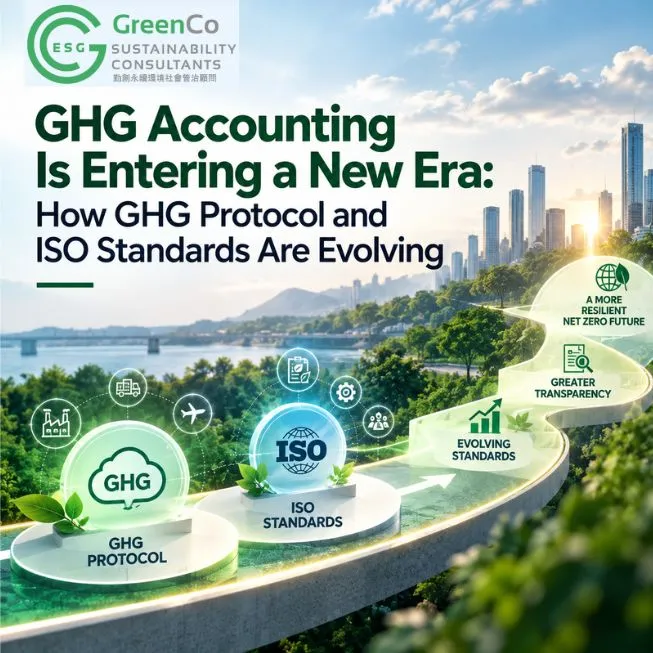
At the centre of this development are two of the most influential systems for GHG accounting: the GHG Protocol and the ISO 14064 standard. In 2026, these two systems are entering an important new phase, as the GHG Protocol and the International Organization for Standardization (ISO) will combine their corporate carbon accounting standards into a single, harmonized global corporate standard.
This is more than a change in terminology. It will shape how companies define their emissions boundaries, collect activity data, calculate emissions and build reliable climate data systems in the years ahead.
GHG Protocol and ISO: Two Pillars of Corporate GHG Accounting
The GHG Protocol is one of the most widely recognised frameworks for corporate GHG accounting globally. Developed by the World Resources Institute (WRI) and the World Business Council for Sustainable Development (WBCSD), it provides a common framework for companies to measure and report their GHG emissions across Scope 1, Scope 2 and Scope 3. Since the publication of its first Corporate Standard in 2001, the GHG Protocol has become a widely adopted reference for corporate GHG accounting and disclosure.
The ISO 14064 series provide an international standards framework for GHG quantification, reporting and verification. ISO 14064-1 focuses on organisational GHG inventories, while the wider ISO 14064 series extends to GHG projects and verification. Other related standards, such as ISO 14067 and ISO 14068-1, address product carbon footprints and carbon neutrality respectively, giving ISO a broader scope across different aspects of GHG management.
Together, the GHG Protocol and ISO have become important reference points for corporate GHG accounting. While their structures and purposes differ, there is significant overlap at the organisational level, creating a foundation for greater alignment between the two systems.
2026–2028: GHG Protocol and ISO Move Towards Greater Alignment
GHG accounting standards are not static. Over recent years, both the scope and expectations surrounding GHG accounting have continued to evolve.
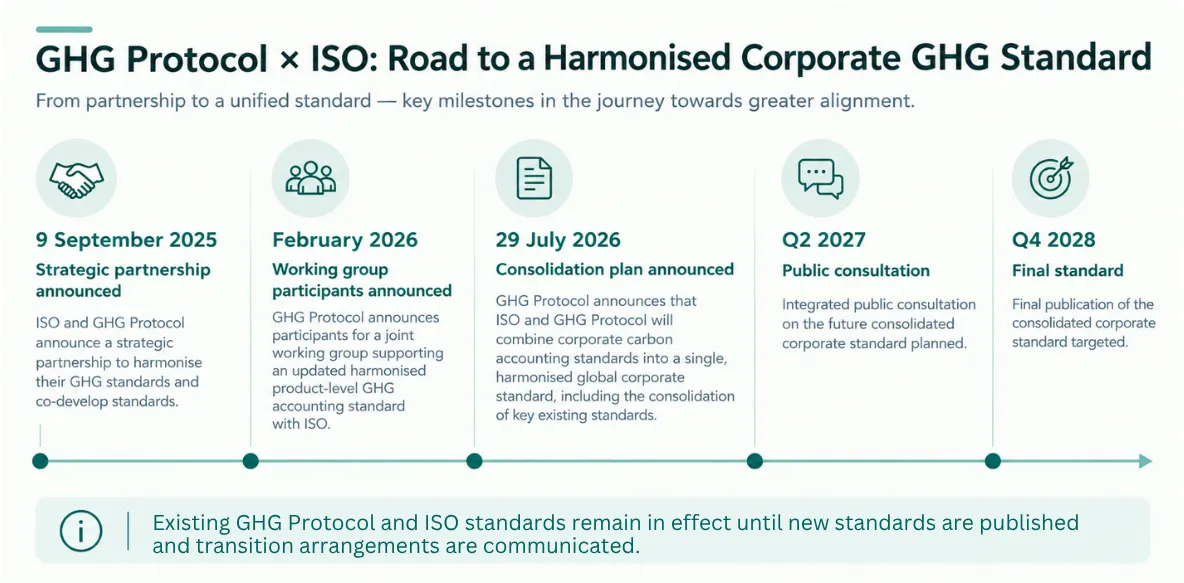
A significant milestone came in 2026. GHG Protocol and ISO announced plans to consolidate corporate GHG accounting standards into a common corporate standard. The updated standard will consolidate GHG Protocol’s corporate level standards—Corporate Standard (2004), Scope 2 Guidance (2015), Scope 3 Standard (2011), Actions and Market Instruments workstream, and ISO’s 14064-1 standard.
The process will take time. A public consultation on the consolidated corporate standard is currently planned for Q2 2027, with final publication targeted for Q4 2028. This means that 2026 should not be interpreted as the year in which a new consolidated standard has already taken effect. Instead, it is a critical transition and preparation period.
The move towards a common corporate standard reflects the growing need for a more consistent approach to GHG accounting. With companies and stakeholders working across different frameworks and reporting requirements, greater alignment can help reduce methodological differences and unnecessary duplication, making GHG information more comparable and easier to use. For companies, this could also make the accounting and reporting process more streamlined, while providing a stronger and more consistent basis for climate-related decision-making.
The Real Issue Is Not Just the Standard.
For companies, the most important question arising from these developments may not simply be whether to use GHG Protocol or ISO.
The more fundamental question is:
Does the company have a reliable, transparent and traceable GHG data system?
A high-quality GHG inventory is not simply a final figure. A company should be able to explain where that figure came from: how its organisational and operational boundaries were defined, where the activity data originated, which emission factors were used, what calculation methodologies were applied, and how estimates were developed where primary data was unavailable.
This becomes particularly important for Scope 3. While many companies have established relatively stable processes for Scope 1 and Scope 2, Scope 3 inventories can still rely heavily on spend-based or other indirect approaches. Companies can progressively improve data quality by moving from spend-based to supplier-specific data, prioritising the categories where better data is both material and feasible.
Companies should also retain historical activity data, calculation files, emission factors, assumptions, estimation methodologies and records of methodological changes. This improves the credibility of current disclosures and, importantly, makes future recalculation far easier when methodologies or standards evolve.
In other words:
What companies need to build today is not simply a GHG inventory that meets one particular standard, but a GHG data management tool that can continue to evolve as the standards change.
How GreenCo Can Support Companies Through the Transition
As GHG accounting standards continue to evolve, companies can take this transition period as an opportunity to strengthen the quality, consistency and usability of their GHG data. GreenCo can support companies in building a more robust GHG accounting and data management foundation through the following key areas:
- GHG Accounting: Support GHG inventories in accordance with the current GHG Protocol and ISO standards, with robust calculation methodologies and documentation.
- Data System Establishment: Establish structured GHG data collection and management processes to improve data quality, traceability and assurance readiness.
- Scope 3 Enhancement: Expand Scope 3 coverage and progressively improve data quality, moving from spend-based estimates towards activity-based and supplier-specific data where feasible.
Ready to strengthen your GHG accounting and data management? Contact GreenCo to learn more about how we can support your organisation.
About GreenCo ESG Consulting
GreenCo is a professional ESG advisory firm accredited with ISO 9001 in the Provision of ESG / Sustainability Reporting, Sustainanbility and Climate Disclosures and GHG Accounting Advisory Services. Established in 2016, we were born to tackle ESG and climate risk management challenges. GreenCo has a professional team consists of talents with multiple backgrounds with
- PhD
- Practitioner Member of the Institute of Sustainability and Environmental Professionals (ISEP)
- CFA (the CFA Institute) and Certificate in ESG Investing
- EFFAS Certified ESG Analyst (CESGA)
- GRI Certified Sustainability Professional
- Certified Public Accountant (for assurance in accordance with ISAE 3000)
- Member of Global Association of Risk Professionals
- Master’s degree in envirnomental science
GreenCo has solid track record in ESG advisory for over 80 listed companies in Hong Kong, Mainland China, Singapore and Korea, covering all industries under the Hang Seng Industry Classification System.