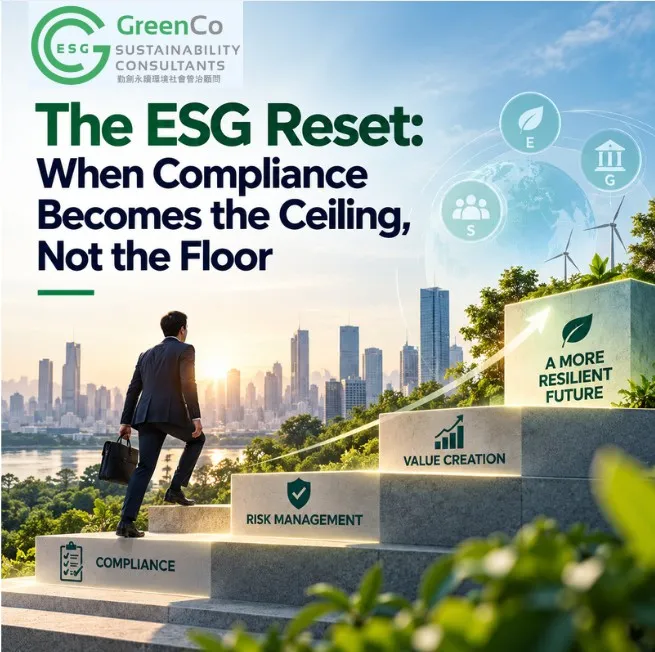
The ESG Reset: When Compliance Becomes the Ceiling, Not the Floor
Sustainability reporting is becoming simpler. But does that mean companies should do less?
After years of expanding sustainability disclosure requirements, the ESG landscape is entering a new phase. Regulators in several markets are reassessing reporting requirements, with a stronger focus on proportionality, reducing administrative burden and concentrating disclosures on information considered most relevant.
The European Union is a prominent example. In July 2026, the European Commission adopted revised European Sustainability Reporting Standards (ESRS), reducing the number of mandatory datapoints by more than 60% and the total number of datapoints by more than 70%.
Elsewhere, however, sustainability reporting continues to develop. Singapore, for example, is progressively implementing ISSB-based climate disclosure requirements, with further requirements and limited assurance being phased in over the coming years.
For companies operating across markets, the message is therefore not simply that ESG is becoming less important.
It is becoming more selective.
From “How much should we report?” to “What actually matters?”
The earlier phase of ESG reporting was often characterised by expansion: more metrics, more disclosures, more frameworks and more requests from investors, customers and business partners.
The current phase is different.
As reporting requirements become more focused, companies have an opportunity to step back and ask a more fundamental question:
Which sustainability issues genuinely matter to our business?
This is where the concept of minimum compliance needs attention.
A compliance-led approach asks:
What do we need to disclose this year?
A more strategic approach asks:
What sustainability-related risks and opportunities could affect our business, and what information do we need to manage them effectively?
The two questions may lead to very different outcomes.
The risk of treating regulatory simplification as an ESG retreat
Reducing reporting requirements can be beneficial. It can reduce unnecessary administrative work, improve focus and allow companies to allocate resources more effectively.
But there is a distinction between reporting less and understanding less.
A company may no longer be required to disclose a particular metric in the same level of detail. That does not necessarily mean the underlying issue has disappeared from its business.
Climate exposure, energy costs, supply chain disruption, workforce challenges, resource dependency and changing customer expectations do not become less relevant simply because a disclosure requirement has been simplified.
For management teams, the question should therefore not be:
“Do we still have to report this?”
but:
“Would it still matter if we stopped monitoring it?”
That is an important distinction between ESG reporting as a compliance exercise and ESG information as a management tool.
Compliance is a floor — not necessarily a strategy
There is nothing wrong with meeting minimum regulatory requirements, when budget and resources are in concern. For many companies, especially those navigating economic downturn and increasingly complex changing rules, establishing a clear compliance baseline is a sensible first priority.
The problem arises when the compliance baseline becomes the ceiling.
A company that only collects information because a regulator requires it may struggle to respond when investors, lenders, customers, employees or supply-chain partners ask questions that go beyond the minimum disclosure requirements.
By contrast, companies that understand the underlying business relevance of their ESG issues can adapt more readily when requirements change.
This is particularly important for companies operating across multiple jurisdictions. Different markets may apply different timelines, reporting thresholds, assurance requirements and local interpretations, even as global convergence around ISSB-based reporting continues.
In such an environment, simply following the minimum requirement in each jurisdiction can create a fragmented reporting process, and potentially duplicate work.
A better approach: build once, use across multiple purposes
Rather than treating each ESG requirement as a separate reporting exercise, companies can take a more integrated approach.
A well-designed ESG data and governance framework can support multiple purposes:
Regulatory disclosure + Investor communication + Customer and supply-chain requests + Internal risk management + Sustainability targets and strategy
This does not mean collecting every possible ESG metric.
It means identifying the information that is genuinely relevant to the business, establishing clear ownership and methodologies, and maintaining data that can be used consistently across different reporting and decision-making needs.
The objective is not more ESG.
It is better ESG information.
The next phase of ESG
The ESG landscape may be moving away from the era of “more disclosure” towards one of more focused, more decision-useful disclosure.
For companies, this presents both a challenge and an opportunity.
Those treating ESG solely as a reporting obligation may find themselves repeatedly adjusting their processes every time regulations change.
Those using the current reset to reassess their material issues, strengthen their data foundations and connect sustainability information with business decisions may be better placed to adapt, regardless of how individual reporting requirements evolve.
At GreenCo, we believe effective ESG reporting should begin with understanding what matters to the business, not simply what appears on a checklist. We help companies translate evolving regulatory requirements into practical reporting and management processes, from materiality assessment and ESG reporting to GHG accounting, climate-related disclosures and ESG data management.
As the ESG landscape resets, the question is no longer simply “How much do we have to report?” It is “What information is important enough for us to understand, manage and act on?”
Contact us today to learn more on how our professional team can help you in establishing the ESG management foundation for long term adaptability.
About GreenCo ESG Consulting
GreenCo is a professional ESG advisory firm accredited with ISO 9001 in the Provision of ESG / Sustainability Reporting, Sustainanbility and Climate Disclosures and GHG Accounting Advisory Services. Established in 2016, we were born to tackle ESG and climate risk management challenges. GreenCo has a professional team consists of talents with multiple backgrounds with
- PhD
- Practitioner Member of the Institute of Sustainability and Environmental Professionals (ISEP)
- CFA (the CFA Institute) and Certificate in ESG Investing
- EFFAS Certified ESG Analyst (CESGA)
- GRI Certified Sustainability Professional
- Certified Public Accountant (for assurance in accordance with ISAE 3000)
- Member of Global Association of Risk Professionals
- Master’s degree in envirnomental science
GreenCo has solid track record in ESG advisory for over 80 listed companies in Hong Kong, Mainland China, Singapore and Korea, covering all industries under the Hang Seng Industry Classification System.